advertisement
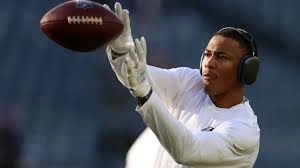
THE HIDDEN PROBLEM NO ONE IS TALKING ABOUT! Eagles' Makai Lemon Pick Creates a MASSIVE DeVonta Smith Dilemma — Is Philadelphia's Receiving Corps TOO Small?!
The Philadelphia Eagles may have made an excellent football pick when they traded up to select USC wide receiver Makai Lemon with the 20th overall selection in the 2026 NFL Draft. On paper, adding a Biletnikoff Award winner to any roster is a no-brainer. But dig a little deeper, and a TROUBLING pattern emerges — one that could have significant consequences for the Eagles' offense and the future of their receiving corps. The problem is not about talent; it is about SIZE, and it revolves around the relationship between Lemon and the Eagles' existing star receiver, DeVonta Smith.
With A.J. Brown almost certainly on his way out — sources have indicated that a trade to the New England Patriots is likely once June 1 arrives — the Eagles' receiving group will be headlined by Smith but also include Lemon, Dontayvion Wicks, Hollywood Brown, and Elijah Moore. These are all quality wide receiver talents, there is no denying that. But there is something strikingly common among them: none of them are particularly big. Lemon is a playmaker, but he is much closer to Smith's size than to Brown's. Hollywood Brown and Moore are also on the smaller, faster side of the spectrum. Wicks, at 6-foot-1 and a great jumper, is the "big guy" of the group, but he does not have the physical presence of a true possession receiver.
This raises a LEGITIMATE question: does the Eagles' offense need a big, strong, physical receiver to operate at its highest level? Can Jalen Hurts thrive with a collection of smaller, craftier receivers who win with speed and route-running rather than size and physicality? It is not a trivial concern. In the red zone, on third-and-long, and in the playoffs when defenses tighten up, having a receiver who can box out a defender and come down with a contested catch is INVALUABLE. The Eagles may have just sacrificed that element of their offense by drafting Lemon instead of a bigger target.
Hurts would surely like to have a guy he can throw the ball up to and trust to go up and catch it. That is what Brown provided — a physical mismatch that defenses had to account for on every play. Without that element, the Eagles' offense may become more one-dimensional, relying on precision and speed rather than power and physicality. Maybe Wicks will develop into that kind of receiver, but it is a big ask for a player who has yet to establish himself as a consistent starter.
The irony is that the Eagles' decision to draft Lemon may have been the BEST available move at the time. He was the top receiver on their board, and passing on him to reach for a bigger receiver would have been a mistake in its own right. But the consequences of this pick extend beyond Lemon himself — they affect the entire construction of the receiving corps and the way the Eagles' offense will function in 2026 and beyond.
The Eagles' front office is well aware of this dynamic, and it would not be surprising to see them address the size issue through free agency or a future trade. In the meantime, the pressure will be on offensive coordinator Kellen Moore to design schemes that maximize the strengths of his smaller, faster receivers while minimizing their limitations. It is a challenge, but not an insurmountable one — and if anyone can figure it out, it is a coaching staff that has proven its creativity time and time again.
advertisement
Related Articles
advertisement